Error loading page.
Try refreshing the page. If that doesn't work, there may be a network issue, and you can use our self test page to see what's preventing the page from loading.
Learn more about possible network issues or contact support for more help.

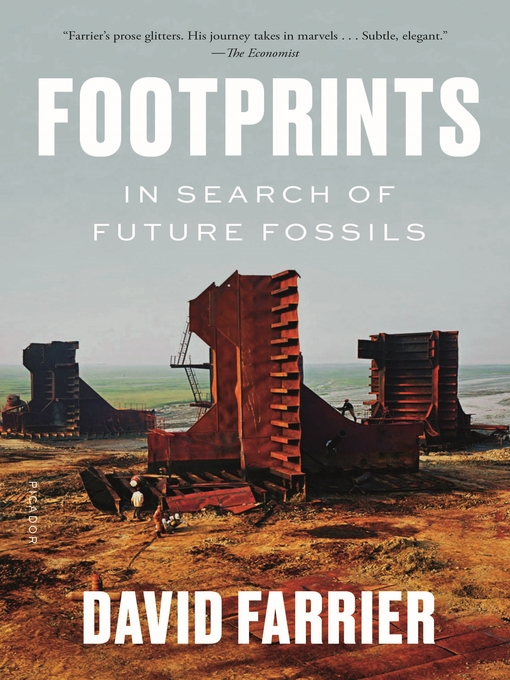
Footprints

In Search of Future Fossils

ebook
1 of 1 copy available

A profound meditation on climate change and the Anthropocene and an urgent search for the fossils—industrial, chemical, geological—that humans are leaving behind
What will the world look like in ten thousand years—or ten million? What kinds of stories will be told about us?
In Footprints: In Search of Future Fossils, the award-winning author David Farrier explores the traces we will leave for the very distant future. Modern civilization has created objects and landscapes with the potential to endure through deep time, whether it is plastic polluting the oceans and nuclear waste sealed within the earth or the 30 million miles of roads spanning the planet. Our carbon could linger in the atmosphere for 100,000 years, and the remains of our cities will still exist millions of years from now as a layer in the rock. These future fossils have the potential to reveal much about how we lived in the twenty-first century.
Crossing the boundaries of literature, art, and science, Footprints invites us to think about how we will be remembered in the myths and stories of our distant descendants. Traveling from the Baltic Sea to the Great Barrier Reef, and from an ice-core laboratory in Tasmania to Shanghai, one of the world's biggest cities, Farrier describes a world that is changing rapidly, with consequences beyond the scope of human understanding. As much a message of hope as a warning, Footprints will not only alter how you think about the future; it will change how you see the world today.

  • Creators

  • Publisher

  • Release date

  • Formats

  • Accessibility

    The publisher provides the following statement about the accessibility of the EPUB file supplied to OverDrive. Experiences may vary across reading systems. After borrowing the book, you may download the EPUB files to read in another reading system.

    Ways Of Reading

    • No information about appearance modifiability is available.

    • Not all of the content will be readable as read aloud speech or dynamic braille.

    Conformance

    • No information is available.

  • Languages

  • Reviews

    • Library Journal

      Starred review from January 1, 2020

      Farrier (English literature, Univ. of Edinburgh; Anthropocene Poetics) explores what traces of present societies will persist into the deep future, traveling the world to report from places rich in future footprints. These journeys include everything from observing plastics washed up on the shore of the North Sea to a deep pit of nuclear waste in Finland to "single, endless" Shanghai to Australia's Great Barrier Reef. Farrier begins in the mid-20th century, with its burgeoning global population and consumption, along with a significant increase in the use of plastics, nuclear weapons testing, and more, explaining how these factors relate to and impact our industrial, chemical, and geological activity. Blending science, literature, and art, this work leads readers to imagine time, backward and forward; writing in a remarkably fluid style, Farrier is as adept at retelling ancient myth as he is at explaining little-known science. Lastly, Farrier offers considerations for fans of popular science and future geologists to ponder; for example, what will remain of New York and Mumbai in the distant future. VERDICT A compelling thought experiment that is sometimes unsettling in its findings but always cleverly conceived and beautifully expressed.--Robert Eagan, Windsor P.L., Ont.

      Copyright 2020 Library Journal, LLC Used with permission.

    • Kirkus

      January 1, 2020
      Elegiac views of the Anthropocene, an age of decline in everything but the consumption of plastics. There have been many recent books on the environmental terrors of the present era, from Elizabeth Kolbert's Sixth Extinction to Gaia Vince's Adventures in the Anthropocene and Barry Lopez's Horizon. Farrier (English Literature/Univ. of Edinburgh; Anthropocene Poetics: Deep Time, Sacrifice Zones, and Extinction, 2019, etc.) adds a side note to these more urgent and compelling books with a fruitful premise: It's up to us, to some degree or another, to determine what we'll leave in the fossil record, and those future fossils will in turn "record whether we carried on heedlessly despite the dangers...or whether we cared enough to change our course." Though the great British ecologist James Lovelock has lately expressed doubt that our kind is smart enough to fix the mess we've caused, Farrier takes a more generous view. On the matter of plastics, for instance, he doesn't dispute that at first, they seemed a wonderful thing, a substitute for so much else that was fragile or scarce. However, as the author puts it, if the world's factories were producing 2 million metric tons of plastic in 1950, "by 2015, it was four hundred million," and not only that, but "it is likely that every single piece of plastic ever produced and not incinerated still exists somewhere in some form." Elsewhere, Farrier looks at the structure of landfills, the nature of cities, the alarming decline in the quantity not just of terrestrial species and their members, but also those of microbiota, the collapse of coral reefs--a collapse that can be bandaged but not undone by, yes, plastic poultices--and the eerie silences that surround a world in collapse even amid all the noise humans make. The feel of the text is matter-of-fact melancholic, a too-little, too-late somberness. If those other books (and others besides them) have already reported most of the data, the author captures a moment that finds us standing on the brink. There's not much new here, but Farrier sounds a convincing argument all the same.

      COPYRIGHT(2020) Kirkus Reviews, ALL RIGHTS RESERVED.

    • Booklist

      Starred review from March 1, 2020
      What traces will modern humans, propelled by fossil fuels, nuclear power, and plastic, leave on our planet? A University of Edinburgh English professor inspired by paleontology and poetry, Farrier anchors his imaginative quest for future fossils to two discoveries made in May 2013: 850,000-year-old human fossil footprints on the coast of England, and the highest atmospheric level of carbon dioxide in all of human history. In search of our footprints as we precipitously warm the planet; change the chemical composition of air, oceans, soil, and microbes; raise sea levels, and catalyze a mass extinction, Farrier travels to the endangered Great Barrier Reef, flood-vulnerable Shanghai, an ice-core laboratory, and the Baltic Sea, learning from scientists and absorbing the scenes. His in-the-moment descriptions are precise and vital, but he renders them uniquely evocative and haunting by paralleling current dilemmas with ancient myths, Greek tragedies, literature, and art. Farrier further guides us to new and wrenching environmental perceptions by tracking the long lives of a plastic bottle and nuclear waste, increasing jellyfish blooms, and the toxic markings of mines, drugs, roads, and the carbon-burning servers powering our consuming digital lives. Farrier sees Earth as a vast library, and encourages us to recognize and think deeply about the indelible stories of destruction and catastrophic loss we're adding to the planet's archive.(Reprinted with permission of Booklist, copyright 2020, American Library Association.)

Formats

  • Kindle Book
  • OverDrive Read
  • EPUB ebook

Languages

  • English

Loading