 Dec 01 2026
 Nov 01 2026
 Oct 01 2026
 Sep 01 2026
 Aug 01 2026
 Jul 01 2026
 Jun 01 2026
 May 01 2026
 Apr 01 2026
 Mar 01 2026
 Feb 01 2026
 Jan 01 2026
 Dec 01 2025
 Nov 01 2025
 Oct 01 2025
 Sep 01 2025
 Aug 01 2025
 Jul 01 2025
 Jun 01 2025
 May 01 2025
 Apr 01 2025
 Mar 01 2025
 Feb 01 2025
 Jan 01 2025
Beat combines competent hardware and software tests with dedicated reviews as well as reports and interviews from musicians and the music business. We will report on music production with the latest synthesizers and computers, introduce new trends in recording, and always have our finger on the pulse with up-to-date reports. Many well-known specialist report on the widespread music production solutions and experienced editors take care of the most important entertainment and scene topics. This magazine is a platform for musicians and contains a regular demo and MP3 section for readers as well as a download with high-quality sample and music files for creative musicians. Software licenses available while stock lasts. You can check the availability of each product here: www.plugins-samples.com/all-issues
What musicians need to know
SOFTWARE HIGHLIGHTS
Navigator: Best of Beat # 251
Magazine
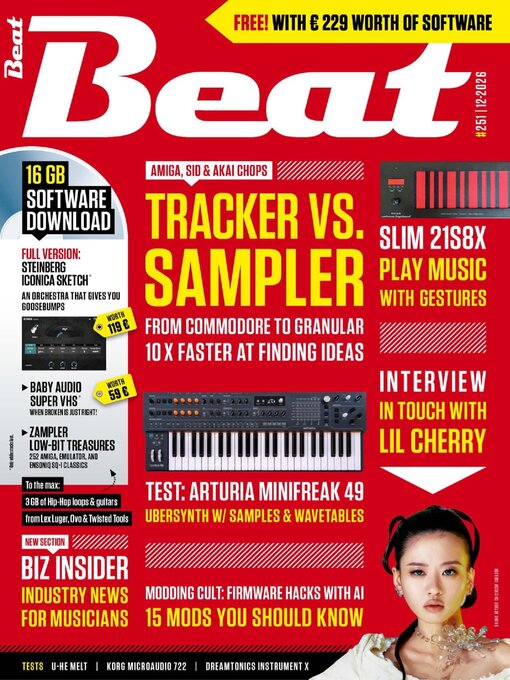
The Business is changing. What matters right now. • With BEAT Business Insider, we’re launching a monthly column that breaks down industry news into what it means for you as a musician. To kick things off, we’ll cover the controversy surrounding Suno V6’s training data, Spotify’s new rules for virtual AI artists, and the question of how much of the growing streaming revenue actually reaches you. In an interview, Anselm Kreuzer from Music Sculptor explains how AI is changing production music and what opportunities are still available to composers today.
Anselm Kreuzer (Music Sculptor) in Talks How AI Is Changing Production Music • A good track alone isn‘t enough: If you want to make money with Production Music, you need to know how it‘s used in film, TV, and social media. Anselm Kreuzer has been composing Production Music for more than 25 years and, as co-founder and CEO, heads Library Music Sculptor. In this interview, he explains what makes a track suitable for placement, where revenue comes from, and how AI is changing the market.
TRACKER VS. SAMPLER FROM COMMODORE TO GRANULAR 10 TIMES FASTER THAN WITH YOUR DAW • Why do top producers still swear by the Amiga, C64, vintage samplers and modern trackers like Renoise or Polyend? Simple: uncompromising speed, no decision paralysis, and a distinctive character no VST can fake. In this in-depth masterclass, we show you how to use tracker workflows, 8-bit punch and micro-editing not just for chiptunes, but to give your techno, hip-hop, trance and D&B tracks a fresh new edge. From trackers, we branch out into the world of modern hardware samplers, packed with inspiring features ranging from granular synthesis to glitch effects, so running out of ideas will no longer be part of your vocabulary. Ditch the mouse – bring on the style and flow!
The 7 differences to your DAW • Visually, trackers are a far cry from the familiar arranger timelines of Cubase and Logic or the clip matrix popularised by Ableton. Technically, though, they do the same thing: feed notes to synths and samplers. You just need to think a little differently. That’s why we’ve summarised the key differences here to make getting started or switching over a little easier. It’s worth it!
Working without undo • Ready? Because now we’re getting down to business. Get ready for minimalism, austerity and doing without every little convenience – or, to put it more positively, stripping things back, slowing down and finding fresh inspiration. In this age of digital overload, that can’t be a bad thing. And you’ll notice that after the first hour of plenty of head-scratching, something suddenly clicks and the musical sun starts shining. Promise!
Renoise: the bridge from tracker to studio • In this exclusive interview, Renoise creator Eduard Müller, aka taktik, explains why vertical sequencing makes traditional DAWs look outdated, how modern sampling works, and why tracker aesthetics are more relevant than...